
The celebrations are set to continue through the day. CMS also arranged a live AXIOM mission broadcast, a replica of the ISS Cupola module, a "Defy Gravity" photo booth, telescope viewings, and a simulated Mission Control Centre.

Lucknow celebrated the successful return of astronaut Group Captain Shubhanshu Shukla from the International Space Station (ISS). Family, friends, and the community rejoiced as Shukla, the first Indian astronaut to visit the ISS, made a successful splashdown in the Pacific Ocean.

The Moon Mineralogy Mapper or M3 has confirmed existence of water on moon by analysing the data collected from Chandrayaan-I.
The team led by researchers from the University of Hawai'i (UH) at Manoa in the US discovered that these electrons in Earth's plasma sheet are contributing to weathering processes -- breaking down or dissolving of rocks and minerals -- on the Moon's surface.

The Vikram lander was 100 kilometers away from LRO, near Manzinus crater in the Moon's south pole region, when LRO transmitted laser pulses toward it on December 12 last year.

India is now on the Moon and the success of the lunar mission has sounded the bugle for the emergence of a developed nation, Prime Minister Narendra Modi said on Wednesday as Chandrayaan-3 landed successfully on the lunar surface.

It is unclear if this episode will affect or prevent the lunar lander -- which was slated to land near the moon's south pole as soon as Monday -- from attempting a touchdown.

The entire process being autonomous when the lander has to fire its engines at the right times and altitudes, use the right amount of fuel, and scan of the lunar surface for any obstacles or hills or craters before finally touching down.

The agency said it is currently receiving a signal from the lander, which is communicating as expected.
While the historic success of Chandrayaan-3 is celebrated by Indians across the world, two untrumpeted engineering colleges in Kerala are basking in the glory of the key role played by some of their alumni in the crucial Moon mission.

Chandrayaan-3 mission's lander 'Vikram' chose a relatively flat region on the lunar surface to touch down, images captured by its camera showed.
Shukla created history on Wednesday by embarking on a journey to the International Space Station (ISS) as part of a commercial mission operated by Axiom Space, along with three other astronauts.
The space agency has redefined the mission in such a way that it will achieve success in the very first attempt.

The video showed the Moon in bluish green colour with many craters.
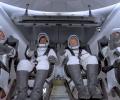
The Lucknow-born Shukla, former NASA astronaut Mission Commander Peggy Whitson, Slawosz Uznanski-Wisniewski of Poland, and Tibor Kapu of Hungary are part of the Axiom-4 mission that marks the return to space for the three nations.
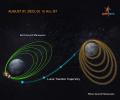
The ISRO had said it would attempt softlanding on the lunar surface on August 23.

India on Wednesday joined an elite group of three nations to have sent a spacecraft on the Moon, as Chandrayaan-3 landed a rover on the lunar surface to explore the uncharted territories near the south pole.

India's lunar mission Chandrayaan-3 holds immense potential for gathering critical data and will significantly contribute to the understanding of the Moon, a former top National Aeronautics and Space Administration (NASA) official has said, describing India-United States space partnership further moving to the moon.
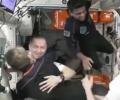
India's Group Captain Shubhanshu Shukla and three other astronauts on Thursday reached the International Space Station as the Dragon spacecraft docked with the orbital laboratory.

India's first unmanned spacecraft Chandrayaan-1 entered the lunar orbit on Saturday after Indian Space Research Organisation scientists successfully carried out a highly complex and tricky manoeuvre crossing another historic milestone in the country's space programme.
The National Aeronautics and Space Agency on Thursday revealed that India's maiden lunar mission Chandrayaan-I spacecraft had traced water molecules on the lunar surface of the moon.

ISRO made efforts to re-establish communication with rover Pragyan and lander Vikram after they were put into sleep mode in September following the onset of night on the moon.
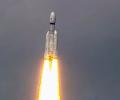
The Chandrayaan-3 mission that aims for a soft landing on the moon's surface, paving the way for future interplanetary missions, carries six payloads that would help ISRO understand the lunar soil and also get the blue planet's photographs from the lunar orbit.
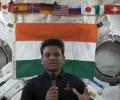
Shukla shared these details in an 18-minute interaction with Prime Minister Narendra Modi on Saturday from the International Space Station that is orbiting the earth at an altitude of 400 km.
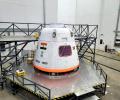
Modi gave these directions during a meeting to review the preparedness of the Gaganyaan mission and the first demonstration flight of the crew escape system test vehicle scheduled for October 21.

ISRO on Monday said the Vikram lander successfully underwent a hop test when it made the soft-landing again on the lunar surface.

A lunar orbiter has spied spacecraft and astronaut tracks on the Moon left behind almost 40 years ago.

The Vikram Moon Lander, named after the father of India's space mission Vikram Sarabhai on his birth centenary year, is scheduled to touch the lunar surface near its south pole on September 7 about 1.55 am.

Singh also said a final decision on the launch of India's sun mission 'Aditya-L1', scheduled for September 2 at present, will rest on the prevailing cosmic aspects.

Scientists at ISRO used the orbiter high resolution camera onboard the Chandrayaan-2 orbiter to study the lunar surface hours before and after the soft-landing of Vikram lander on the moon on August 23.
The Indian Space Research Organisation (ISRO) has successfully de-docked the SpaDeX satellites, a significant achievement that clears the path for future missions such as exploring the moon, human spaceflight, and building India's own space station. The de-docking, announced by Union Minister Jitendra Singh, follows a successful docking experiment conducted in January. The SpaDeX mission involved launching two satellites, SDX01 and SDX02, to demonstrate the docking technology in space.

Here is a glimpse of the journey of India's third lunar exploration venture has taken so far.

After the successful deployment of Chandrayaan-3's lander and rover on the moon, Indian Space Research Organisation (ISRO) is hoping that their mission life will not be limited to one lunar day or 14 earth days, and that they will come back to life when the sun again rises on the Moon, to carry on with the experiments and studies there.

The mission objectives of Chandrayaan-3 are to demonstrate a safe and soft landing on the lunar surface, to demonstrate rover roving on the Moon, and to conduct in-situ scientific experiments.
The Indian Space Research Organisation has declared that Chandrayaan-1, India's first moon mission is over.
In a landmark discovery, India's maiden moon mission Chandrayaan-I has found evidence of water on the lunar surface, a finding that could trigger a serious hunt for life in outer space.

A team of Indian Space Research Organisation scientists on July 13 visited the Tirupati Venkatachalapathy temple ahead of Friday's much anticipated Chandrayaan-3 launch.
The Lunar Mission, Chandrayan-I, would cost Rs 386 crore with the foreign exchange component estimated at Rs 210.90 crore.
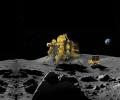
This eagerly anticipated event will be broadcast live on August 23, starting from 17:27 Hrs IST on multiple platforms, including the ISRO Website, its YouTube channel, ISRO's Facebook page, and DD National TV channel.

The ISRO chief further said that the ISRO is ready to fulfill the vision put forth by Prime Minister Narendra Modi.
 © 2026 Rediff.com - Advertise with us - Disclaimer - Privacy Policy - Sitemap - Feedback - About us - Terms of use - Grievances